Mobile Industry /
Fate Grand Order Leads Japan's Android Revenue Rankings Ahead of Samurai Remnant Collaboration
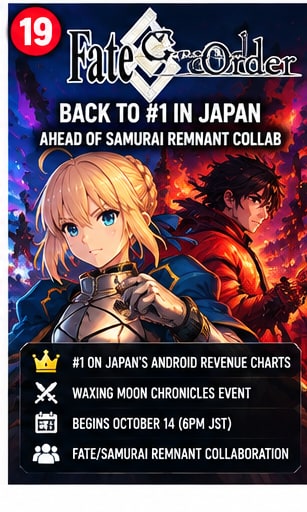
Fate/Grand Order reclaims first place on Google Play Japan grossing charts as the Fate/Samurai Remnant Waxing Moon Chronicles rerun kicks off.
Key facts
- Topic:
- Mobile Industry
- Published:
- 2026-10-14
- Reported by:
- Gameforce Mobile News Desk
Key takeaways
- Fate/Grand Order reclaims #1 on Japan Google Play gaming revenue charts on October 14.
- Driven by the return of Fate/Samurai Remnant collaboration Waxing Moon Chronicles.
- Genshin Impact also rebounds into Japan's top ten grossing chart at position nine.
Fate/Grand Order has returned to the top of Japan's Google Play gaming revenue rankings, according to industry data published on October 14. The game occupied first place at approximately 9:30am Japanese time, ahead of a scheduled collaboration event connected to Fate/Samurai Remnant. The returning event, titled Waxing Moon Chronicles, is scheduled to begin at 6pm Japanese time on October 14.
It brings content inspired by the action RPG Fate/Samurai Remnant back into the mobile game, providing additional activities for established players and opportunities to revisit characters associated with the collaboration. Industry observers expect accompanying character recruitment campaigns to contribute to commercial performance, although those expectations should not be confused with confirmed future revenue. The ranking also revealed movement elsewhere in Japan's mobile market.
HoYoverse's Genshin Impact climbed from thirteenth to ninth position, returning to the top ten. These figures represent storefront chart positions rather than independently audited sales totals. Nevertheless, they illustrate the continuing commercial strength of established Japanese role-playing franchises. Fate/Grand Order has maintained a substantial audience through character collection, elaborate storytelling and frequent events that connect different parts of the wider Fate universe.
The success of such collaborations demonstrates how intellectual property can support long-term engagement when players have developed strong attachments to particular characters. For competitors attempting to enter the Japanese market, the lesson is uncomfortable but clear. A new mobile game must compete not only against other gameplay systems but also against years of accumulated emotional investment. Apparently even the Holy Grail cannot make customer acquisition particularly easy.